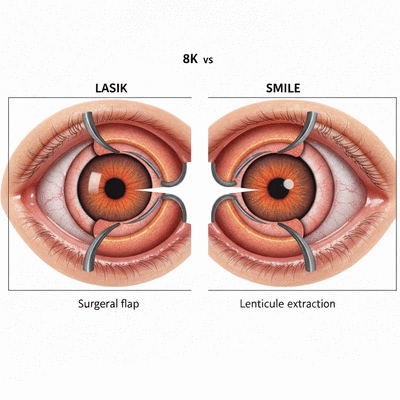
LASIK: Flap Creation Technique
- A thin corneal flap is created.
- Underlying tissue reshaped by laser.
- Flap repositioned to heal naturally.
Quick recovery, but flap risks exist.
Welcome to Singapore Eye Centre!
Dec 11
Are you ready to unlock the secrets of vision correction? Understanding LASIK and SMILE could transform your journey toward clearer sight. Here’s what you can gain from exploring these two innovative procedures.
Delve into the core differences between LASIK and SMILE refractive surgeries, exploring their techniques, impact on corneal strength, and technological distinctions.
As an ophthalmologist here at Singapore Eye Centre, I often hear patients asking about their options for vision correction. When it comes to refractive surgery, both LASIK and SMILE are popular choices, but they operate quite differently. Let’s take a closer look at what each procedure entails and how they can impact your vision journey!
Understanding the nuances between these two techniques can empower you to make a well-informed decision about your eye health. So, what exactly are LASIK and SMILE? Let’s dive into the specifics!
LASIK, or Laser-Assisted In Situ Keratomileusis, is a well-established refractive surgery technique. It involves creating a thin flap in the cornea using a special laser. This flap is then lifted to allow another laser to reshape the underlying corneal tissue, correcting vision issues such as myopia, hyperopia, and astigmatism.
Many patients appreciate LASIK for its quick recovery time. Most experience improved vision within a day or two. However, it’s also important to note that the flap created during the procedure can lead to certain risks, which we will explore in more detail later. For a deeper dive into the advantages and disadvantages of each procedure, you can read more about the pros and cons of LASIK vs. SMILE.
On the other hand, SMILE stands for Small Incision Lenticule Extraction. This innovative procedure is flapless, which is a significant difference compared to LASIK. With SMILE, a laser is used to create a small lenticule (a disc-shaped piece of tissue) within the cornea. This lenticule is then removed through a tiny incision, allowing for vision correction without the need for a flap.
SMILE's flapless design offers a promising alternative for those concerned about the LASIK flap. Understanding these differences is crucial in determining which procedure aligns best with your vision goals. For more detailed information, Review of Ophthalmology provides an excellent point-counterpoint discussion on LASIK vs. SMILE.
Now that we’ve covered the basics, let’s compare the surgical techniques of LASIK and SMILE. Both have unique advantages and potential drawbacks, which can make a significant difference in your recovery and visual outcomes.
By examining these factors closely, we can better understand how each method impacts healing and visual results. As always, I’m here to help guide you through these choices, ensuring you find the best option for your personal vision needs.
The method of corneal manipulation is a key distinction between LASIK and SMILE. LASIK involves creating a flap that can sometimes lead to complications, while SMILE’s approach minimizes these risks by omitting the flap entirely. This means less disruption to the corneal structure, which could potentially lead to better long-term outcomes.
The biomechanical properties of the cornea are crucial in determining the safety and effectiveness of refractive surgery. LASIK creates a larger area of tissue removal compared to SMILE, which retains more corneal strength. As a result, patients undergoing SMILE may experience fewer changes in corneal stability post-surgery.
Both LASIK and SMILE utilize advanced laser technologies, yet they differ significantly in their applications. LASIK often employs wavefront technology for customizing treatments, while SMILE utilizes a femtosecond laser for precise tissue removal. Understanding these technologies helps clarify how they can cater to different vision correction needs. For further scientific insights into patient outcomes and satisfaction, you can refer to research published on PubMed.
The fundamental difference lies in their approach to corneal manipulation. LASIK involves creating a thin corneal flap, which is lifted to reshape the underlying tissue, while SMILE is a flapless procedure where a small lenticule of corneal tissue is removed through a tiny incision.
Both LASIK and SMILE generally offer quick recovery times, with many patients experiencing improved vision within a day or two. However, SMILE's flapless technique can sometimes lead to less initial discomfort and a reduced risk of flap-related complications.
Yes, SMILE is often associated with better preservation of corneal strength. Because LASIK involves creating a larger flap, it can lead to a greater reduction in corneal biomechanical integrity compared to SMILE, which removes a lenticule through a small incision, thus maintaining more corneal stability.
Lifestyle factors are crucial. For individuals with active lifestyles or those in professions with a higher risk of eye trauma (e.g., contact sports, dusty environments), SMILE's flapless nature might be preferred due to the absence of flap-related complications. LASIK, while effective, might pose slightly higher risks for such activities.
During your consultation, you should ask about the specific benefits and risks of both LASIK and SMILE in your individual case, the surgeon's experience and volume of procedures for each technique, and the technology they use. It's also important to discuss how your existing eye conditions or lifestyle might affect the suitability of each procedure.
As you consider your options between LASIK and SMILE, what factors are most important to you? Is it the recovery time, the procedure's safety, or perhaps your lifestyle needs? Share your thoughts below:
Deciding between LASIK and SMILE is a significant step toward improving your vision. Personalized assessment is key in this process. By evaluating your lifestyle and eye health, you can make a more informed decision that suits your unique needs. It’s important to consider how your daily activities, work environment, and hobbies might influence your choice of procedure.
For instance, if you lead an active lifestyle or work in a dynamic environment, the less invasive nature of SMILE might appeal to you. On the other hand, LASIK's well-established results can provide peace of mind for many. Think about what matters most to you when it comes to your vision correction journey!
Several factors should guide your decision-making process. Here are some key considerations:
As you weigh these factors, it's helpful to keep a journal of your thoughts. This way, you can revisit what’s most important to you and discuss these insights with your surgeon during your consultation.
Your consultation is a crucial step in your journey. It’s your opportunity to gather information and address any concerns. Here are some important questions to consider:
Asking these questions not only helps you feel more at ease but also demonstrates your commitment to understanding the process. Remember, your comfort and trust in your surgeon are vital for a successful outcome!
Choosing the right surgeon can significantly influence your results. An experienced surgeon brings a wealth of knowledge and skill that can enhance your surgical experience. Look for someone who has performed a high volume of both LASIK and SMILE procedures, as this typically correlates with better outcomes.
Ask about their qualifications, training, and any continuing education they participate in. Additionally, patient reviews can provide insights into their satisfaction rates and the surgeon's ability to address concerns.
Your vision is worth investing in, and finding the right surgeon is a crucial step in ensuring you receive the best possible care. After all, it’s not just about the technique; it’s about the person guiding you through this life-changing experience!
Here is a quick recap of the important points discussed in the article:
Ophthalmologist specializing in LASIK & SMILE. Trusted authority in refractive treatments in Singapore.
Singapore Eye Centre is dedicated to empowering patients with accurate knowledge about advanced vision correction, ensuring they make informed decisions for their eye health. Join us on our blog for insights on vision correction techniques, surgeon expertise, and patient care to enhance your visual freedom.
Ophthalmologist specializing in refractive eye surgery. Trusted authority in LASIK and SMILE procedures in Singapore.
Singapore Eye Centre is dedicated to educating patients about advanced vision correction techniques, empowering individuals to make informed decisions about their eye health. Join her on our platform for insightful articles, patient experiences, and the latest advancements in vision correction, enhancing your journey towards optimal vision.